

Notes on the ontology of generative forms
One might wonder what a sculptor truly feels when their hands first touch a block of untreated marble. The stone is heavy, flawless in its density, and profoundly cold. When carved by a master, it can take on the exact proportions of a human body, capturing the drape of a veil or the tension of a sinew with astonishing realism. Yet, no matter how perfectly the light catches the carved cheekbone, the statue remains eternally still, its surface icy to the touch. A strange paradox emerges here: the realism of the form only highlights the absence of breath. The warmth, the plasticity, the organic vitality - these do not reside in the stone itself, but in the calloused, beating hands of the one who shaped it. It is the creator who lends a momentary, fragile illusion of pulse to the inanimate.
Today, as we observe the rapid emergence of generative moving images, it seems we are encountering a new kind of marble. The algorithmic instruments at our disposal can generate visions of staggering fidelity. They can simulate the exact diffusion of afternoon sunlight through a dusty pane of glass, or the microscopic physics of a water droplet falling against concrete. But like the pristine stone, these sequences, left to their own devices, possess a certain spectral chill. They are realistic, yet often vacant. They echo life without having ever lived it. One is left to ask: who, or what, breathes the warmth into this computational clay?

The Ancient of Days, William Blake, (1794)
Perhaps the answer lies in an ancient cosmological figure: the demiurge. In early philosophical thought, the demiurge was not a supreme deity who created the universe from nothing, but rather an artisan, a craftsman who took pre-existing, chaotic matter and shaped it into a cosmos. In the context of our modern visual landscape, it is a common temptation to view the machine as the creator, the solitary author of the dream. But the instrument is merely the chisel. The true demiurge is the human mind, and the chaotic matter from which we must build is not merely data, but the vast, messy accumulation of human culture. It is our sensitivity, our lived experiences, our opinions, and our quietest griefs. These intangible elements form the actual substance of any art worth holding onto.
When form is severed from this human substance, we are left with a beautiful but haunting emptiness. One might think of Fritz Lang’s Metropolis and the creation of the false Maria. The machine-woman is forged to replicate the organic Maria perfectly. She moves, she speaks, she incites the crowds, yet her flawless mimicry only underscores a profound spiritual void. She is a marvel of engineering, a triumph of the illusion of life, but she carries no internal warmth, no genuine empathy. She is motion devoid of emotion. When synthetic imagery is produced without a guiding human philosophy, it risks becoming exactly this: a dazzling, hypnotic shell that dances flawlessly but has nothing of its own to say.
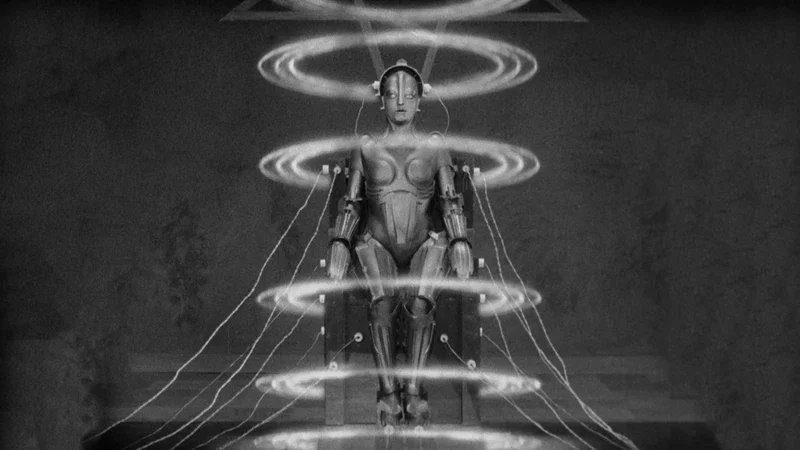
Metropolis, Fritz Lang (1927)
To find the antidote to this coldness, one might look to the final chapter of Andrei Tarkovsky’s Andrei Rublev. The young Boriska, tasked with casting a massive cathedral bell, works in a state of feverish desperation. He does not know the secret of bell-making; he operates on intuition, terror, and an exhausting physical commitment to the mud and fire. When the bell finally rings, its deep, resonant voice is not merely a triumph of metallurgy. It is the sound of human struggle, of faith wrestling with doubt, of sweat and tears poured into the earth. The bell sings because a human being broke themselves to make it. If an invisible mechanism could have cast that same bell with mathematical perfection, devoid of the boy’s trembling hands and hidden fears, it might have produced a sound, but it would not have carried the weight of a soul.
This, it seems, illuminates the quiet responsibility of those who work with today's generative instruments. The role of the creator has not been diminished; it has simply shifted back to its oldest roots. The tools will provide the endless, flawless marble. They will offer the illusion of reality, precise and frictionless. But to make the stone weep, to make the image speak a truth that resonates in the quiet corners of a human heart, requires a demiurge who knows what it means to be alive. The art will not emerge from the sophistication of the chisel, but from the warmth of the hands that guide it, drawing patiently upon the deep, fertile soil of human vulnerability.
